| Where | Great Broughton Village Hall | Type of Event | Illustrated Talk |
| When | Monday 18th May 2026 at 7.30 pm | Tutor | Kate Giles |
The lecture was delivered by Kate Giles, who is a Professor in historic buildings in the Department of Archaeology at the University of York. Dr Giles is also Co-Director of the University’s Centre for the Study of Christianity and Culture. Kate has delivered a talk to the Local History Group before on a medieval building and we were delighted to welcome her back. On this occasion, the attention was focused on a precious object. Kate has a well-deserved reputation as a scholar in this field. We had a good sized audience on a pleasant evening in early summer. Kate’s lecture was clear, lively and well organised. This was a well-researched and mastered subject. There were illustrations of the various aspects of the talk.
The jewel in question was discovered by metal detectorists in 1985. It was subject to an inquest as to its status. As it was found to be lost or abandoned and not deliberately hidden it was declared not to be treasure trove. The jewel went to auction at Sotheby’s in 1986. There was great interest in the auction. Competition was keen between several museums and a number of private collectors. Two museums were the British Museum and the Yorkshire Museum in York. The jewel was sold for £1.3 million.
There was later a dispute about the jewel. Questions asked such as “Where was it found”? The police took an interest but the find was found to be genuine. The jewel disappeared into a private collection for six years. In 1991 the jewel became newsworthy again and it was sold for £2.5 million. The jewel was bought by the Yorkshire Museum using funds raised by public appeal and is currently housed there.
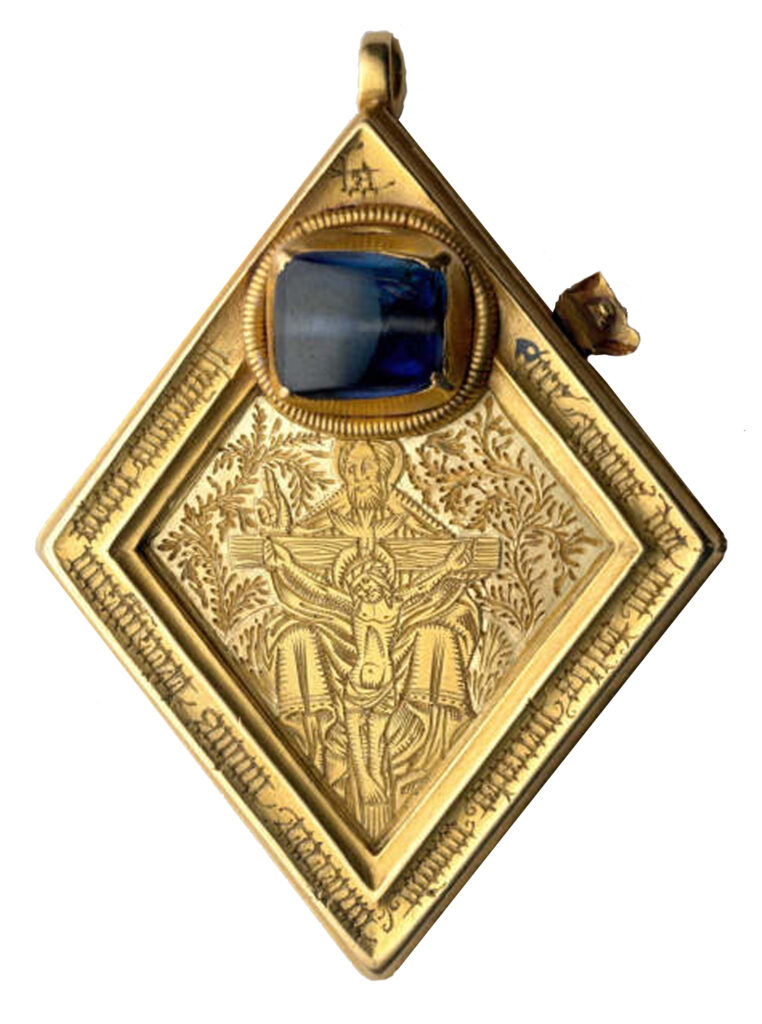
The jewel is English, made of gold and commissioned in the 15th century, probably in London or in York. It is described as exquisite with superb engraving. On the front is the Throne of Mercy. On the back is an image of the Nativity. There are images of saints associated with protecting women in childbirth. The front contains a large sapphire of deep blue. The jewel is a woman’s ornament and the sapphire is associated with purity and chastity.
The original function of the jewel is a locket, probably to contain an agnus dei. When found the locket contained soil and small discs of silk embroidered with gold thread.
There were illustrations of more medieval jewellery which had been found, including the Sheriff Hutton “Bible” and the Hockley Pendant. It was clear from Kate’s lecture that there are still questions to be answered about the jewel, such as “Who had owned it” and where had it been kept. It must have been contained in a bag or a box somewhere because, although it was found in mud, it is unmarked. The research continues.
The material was absorbing and the audience was attentive. The time passed easily and the audience was informed and entertained. There were questions at the end of the presentation and some continued into the later evening. An enjoyable evening.